What Units Would You Use to Measure the Electrical Resistance of a Wire?
Want to larn well-nigh measuring resistance? Basic resistance measurement methods, precautions, and related information
Overview
Electrical resistance plays an extremely important role in the circuitry of electronic devices. Such devices may malfunction if the resistance in their circuitry diverges from the proper level. However, electricity is not visible. A specialized measuring musical instrument is necessary in club to investigate whether a circuit has the proper resistance.
An instrument such as a tester is necessary in society to measure resistance, only how is such measurement carried out? This page provides a detailed introduction to how a tester or multimeter tin be used to mensurate resistance.
How is resistance measured?
Resistance is measured using an musical instrument such every bit an analog multimeter or digital multimeter. Both types of instrument tin measure not only resistance, merely also current, voltage, and other parameters, so they can exist used in a variety of situations.
Nonetheless, resistance measurement does non involve measuring the circuit's resistance value itself. Instead, resistance is calculated by measuring the current and voltage applied to the circuit. When a current is applied to the circuit under measurement, the circuit (resistance) exhibits a voltage (or more precisely, a voltage drop). Resistance tin exist calculated by measuring the electric current and voltage using Ohm'southward Law.
Every bit a issue, a circuit's resistance value tin can be determined if the current and voltage measured values are known. Analog multimeters and digital multimeters utilise the measurement principle of Ohm'southward Law to mensurate resistance.
Resistance measurement with an analog tester
When measuring resistance with an analog multimeter, switch off ability to the excursion nether measurement. Plug the red test lead into the positive input terminal with the "+" marker and the black test lead into the COM input concluding. Switch the instrument to Ω way and set the range button as advisable based on the circuit'due south anticipated resistance.
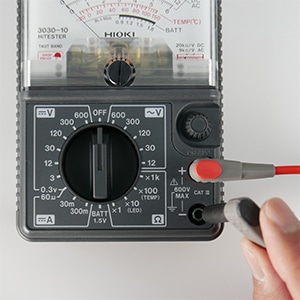
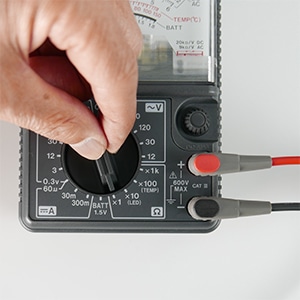
Curt the black and red test pins and gear up the needle to 0 Ω using the 0 Ω adjustment knob. And so place the blood-red and blackness test pins in contact with both ends of the circuit under measurement and read the value indicated past the meter.
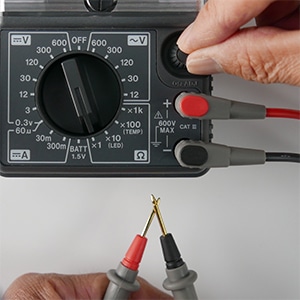
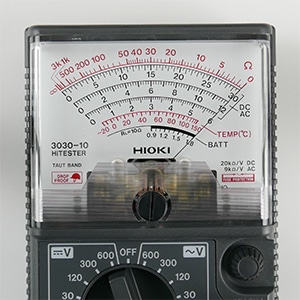
Proceed in mind that applying a voltage to the test leads while the instrument is ready to resistance mode could harm the tester. Additionally, if you are unable to perform 0 Ω correction, the analog multimeter's battery may be low. If you run into this event, check the bombardment's voltage.
-
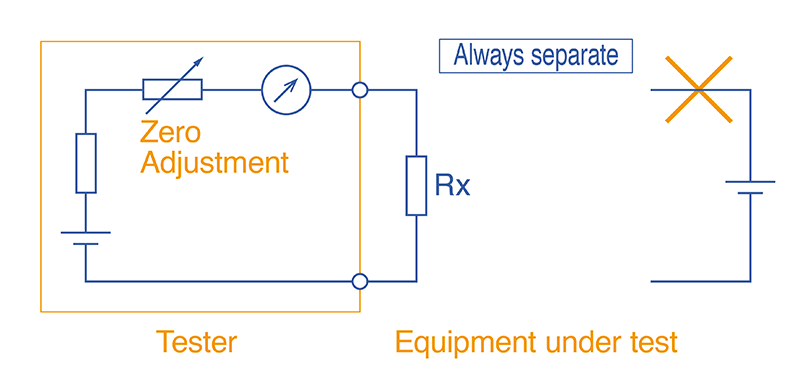
Resistance measurement excursion of an analog meter
Always conduct nix adjustment when measuring resistance.
(Mechanical and electrical nix adjustment)
Situations where voltage is being applied is hazardous, therefore separation is critical.
Resistance measurement with a digital multimeter
In general, resistance is measured with a digital multimeter in the same manner as with an analog multimeter, and it'south a very simple process. The only difference is that the value is indicated digitally instead of by an analog needle; otherwise, the bones method is mostly the same. However, digital multimeters back up two measurement methods:
- Two-last measurement
- Four-last measurement
In most cases, when measuring resistance with a digital multimeter, you'll utilize the two-terminal measurement method. This method applies a constant current and measures the resistance value using the instrument's voltmeter. This method is the same as that used by analog multimeters. However, two-terminal measurement has the disadvantage of yielding resistance values that include the wiring between the instrument and the excursion under measurement.
-
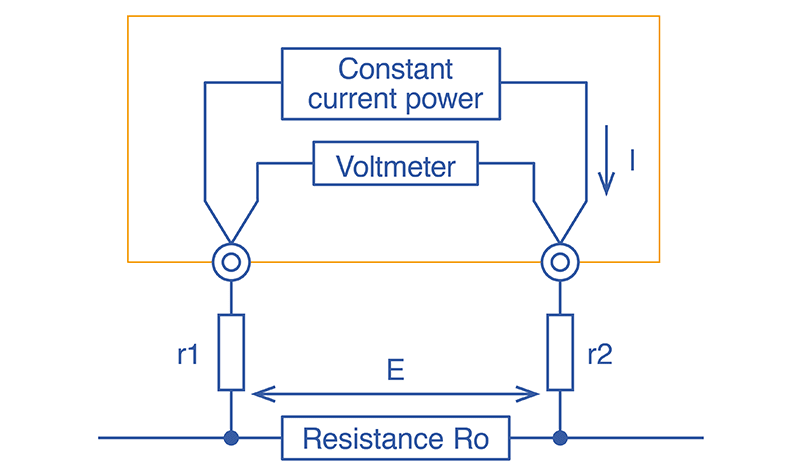
Two-terminal measurement method
To minimize the effects of that additional resistance, the test leads are shorted prior to measurement to cypher-adjust the resistance value. All the same, this technique cannot completely eliminate the furnishings. Iv-terminal measurement was created to address this shortcoming. 4-terminal measurement uses four examination leads and split up voltmeter and ammeter circuits.
-
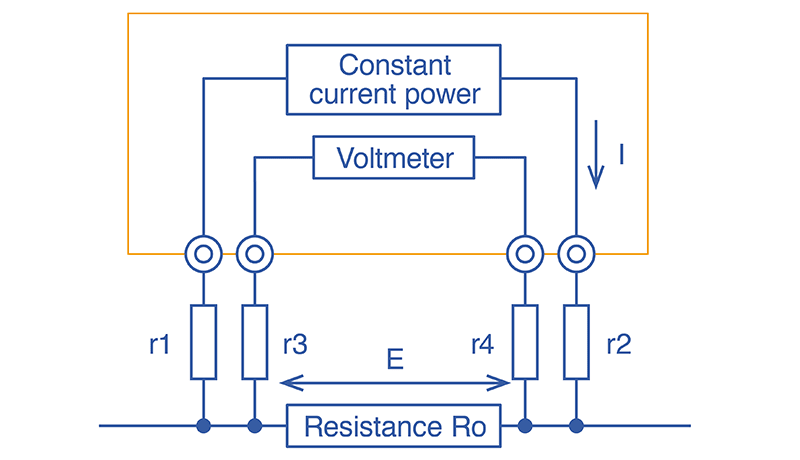
Four-last measurement method
There are various types of resistance, including wire, relay, and connector resistance also equally the internal resistance of batteries, and so it's of import to use the right instrument for the measurement task at hand. When purchasing an instrument, cull one that suits your purpose.
-
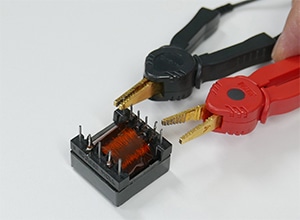
Prune blazon lead
( Clip-type lead for 4-concluding measurement ) -
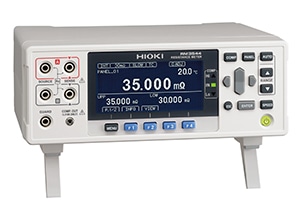
Resistance meters
Sources of fault when measuring resistance
Test leads' wiring resistance is non the only factor that affects resistance value measurement results. The following factors also come into play:
- Electromotive forcefulness
- Thermal racket
- Leakage electric current
- Dielectric absorption
- Friction noise
- External dissonance
- Temperature, humidity, and wind
Resistance meters provide functionality for reducing the effects of temperature and other factors, for example by reading the divergence between a temperature sensor connected to the meter and the reference temperature and correcting resistance values accordingly. If resistance measured values exhibit instability, yous'll need to assess what factors are affecting measurement and take steps to accost them.
Rt = Rt0 ×{ 1 + αt0 × (t - t0) }
Rt:Actually tested resistance [Ω]
Rt0:Compensated resistance [Ω]
t0:Reference temperature [°C]
t:Electric current ambience temperature [°C]
αt0:Temperature coefficient at t0
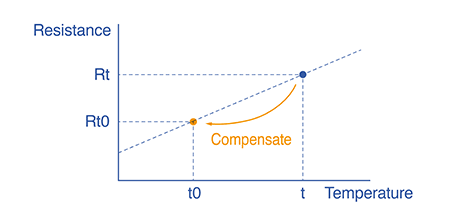
By using a temperature-compensated resistance meter, you can automatically capture the temperature-converted resistance value.
Employ a 4-terminal resistance meter for more authentic low-resistance measurement.
Analog multimeters and digital multimeters use Ohm'south Law to calculate resistance based on electric current and voltage, rather than measuring resistance itself. Both types of instrument are used in the same basic manner. Digital instruments provide features like 4-final measurement for greater accurateness.
Resistance values are affected past a multifariousness of external influences. If measurement results exhibit instability, it'due south necessary to identify the cause and have steps to address it.
Related Products
Source: https://www.hioki.com/global/learning/methods/resistance-measurement-methods.html
0 Response to "What Units Would You Use to Measure the Electrical Resistance of a Wire?"
Postar um comentário